
If you are like most athletes, you haven’t given much thought to your emotions: what they are, why you have them and how they impact your play. Yet science tells us that emotions can have a profound effect on our performances and well-being. Understanding what triggers our emotions, and how and why we react to them, can provide an incredible “secret weapon” to enhance our mental games.
Defining emotions can be a challenge, in large part because emotions are a complicated combination of responses to our inner and outer surroundings. At their most elemental though, emotions are our innermost reactions to our circumstances, our moods, and our relationships with others.
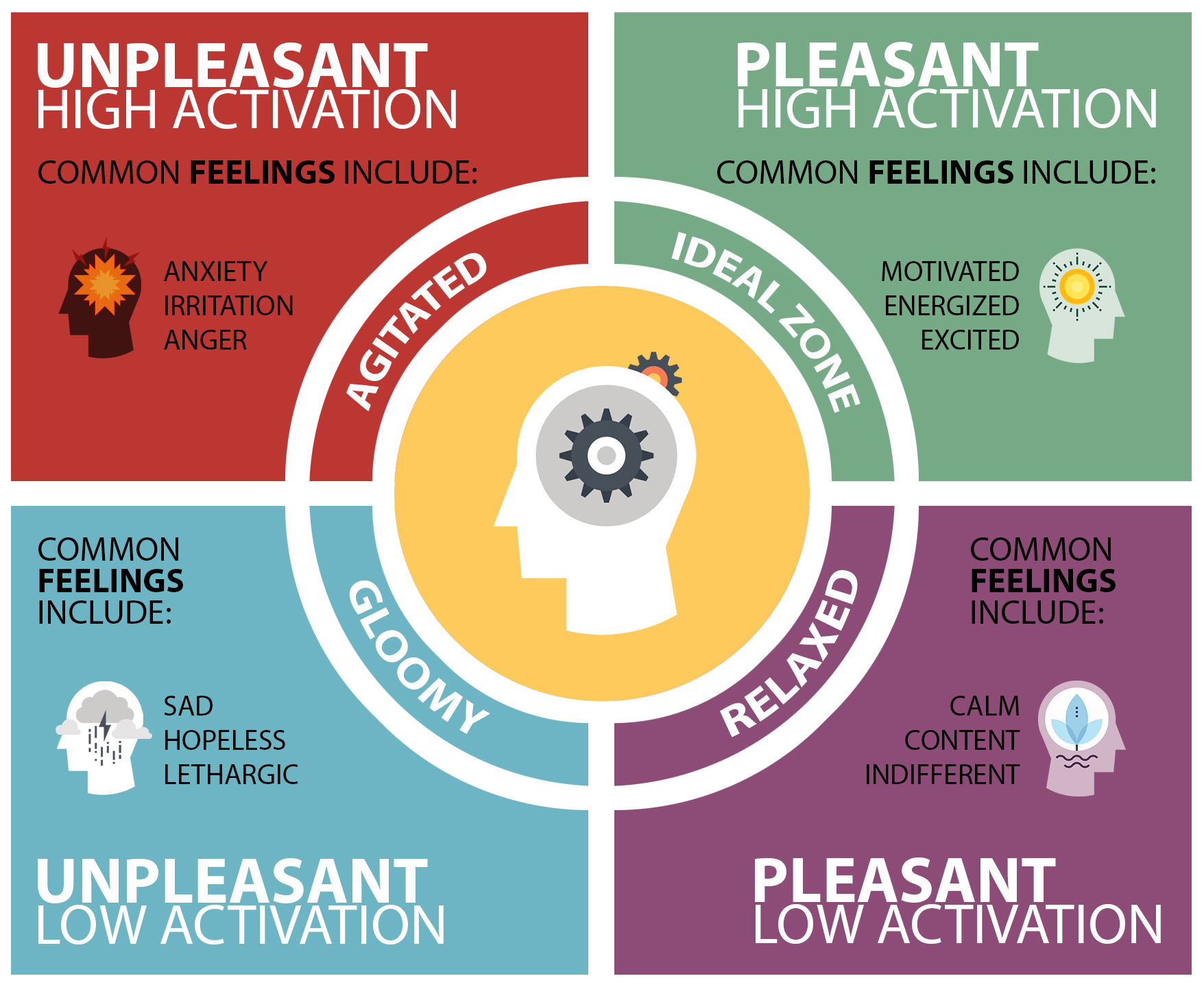
As you can see from the graphic above (Bakker, 2011), all of our emotions are positioned within one of four quadrants, determined by how pleasant or unpleasant we are feeling, and how energized or depleted we are behaving.
The purpose of this module is to give you the tools to maneuver your emotions, whether pleasant or unpleasant, to a position optimal to your performances. Under pressure, on demand, and when fatigued.
Emotions are an integral part of human behavior, so it should come as no surprise that they can play a significant role in athletic performance. From the pre-performance routine to in-game emotional management, athletes and their performances are routinely affected by how they feel before, during, and after competitions. If we’re to manage our emotions, and optimize our state of mind during performances, we must first understand our own emotional tendencies, and what we can and can’t do in response to them. This is called emotional awareness.
So how do we develop our emotional awareness? How do we manage our emotions in a way that enhances our well-being and our performances? We follow a strict sequence of five practical understandings and practices.
First, we get to know our emotions and their triggers.
The easiest way to build emotional awareness is by simply reflecting on how we are feeling from time to time. This is an easy exercise, and can be a momentary part of your daily routine. Just pause periodically throughout the day and ask yourself: how am I feeling? What am I feeling? Give it a name. Are you feeling excited? Hopeful? Inspired?? Restless? Just plain happy? This isn’t a time for the popular meme “meh.” The more specific you can be, the more you will be able to differentiate between similar emotions, and track emotional changes over time.
These self-check-ins are also opportunities to note our triggers. Emotions are reactions– to the world or circumstances around us, to inner disturbances, or to the people and relationships in our lives. So as you note your emotions, take an opportunity to consider any contributing triggers. Perhaps the sun was out and it gave you a jolt of energy. Maybe a meeting with your coach left you inspired, or on the flip side, anxious or on-edge. Or perhaps you simply woke up on the wrong side of the bed and found yourself easily agitated all day. All of these variables are potential triggers, and recognizing not only the range of emotions we feel, but the many potential triggers for those emotions, is an important first step in developing emotional awareness.
EMOTIONAL AWARENESS EXERCISE #1: EMOTIONS LOG
Set an alarm on your phone to go off every couple of hours. When it does, pause and write down the emotion you were experiencing in that moment using the worksheet above. Note also your environment, what you were focusing on, who you were with, and what you were doing. Target 4-5 logs per day, 3-4 days per week. You can dial back the frequency of these logs as time progresses, but in the early stages of your emotional awareness development, it’s best to build positive habits through repetition.
Second, we accept that it is nearly impossible to directly control our emotions.
Whether we’re feeling anxious or flat, angry or indifferent, we can’t consciously will ourselves to feel the way we want to feel. If we could, sport psychologists would be out of business, and all athletes would likely leave their emotions at the door when they entered competition. The good news is that there are things you can do to better regulate your emotions, and since most athletes aren’t doing them, you’ll have a considerable advantage over your opponents once you get them mastered.
Third, we accept whatever emotions we are feeling unconditionally and without resistance.
Fighting our emotions is a losing battle. It saps our energy, steals our focus, and ultimately compounds the problem. Denying our emotions is equally problematic. The best approach is to acknowledge how we are feeling, remind ourselves that these feelings are normal, and shift our attention to actions and behaviors that will get us the results we want– these are our controllables, and we’ll get to them in our next step below the video.
Fourth, we indirectly influence our emotions by focusing on controllables.
Our emotions are largely uncontrollable, but how we respond to them, and how we compete with and in spite of them, is always within our control. Being aware of how we feel, what we want, and how we want to feel gives us options. We can shift our focus from our emotions to the task– whether that be the ball, our mechanics, or our feet. The quickest way to evaporate doubts or negative emotions is to perform the way we know we can (or better) and to have fun, and a focus on the task increases the likelihood of both. Similarly, we can shift our focus from our emotions to our behaviors and act the way we want to feel. This may sound simple and idealistic, but it’s a proven emotional management technique that we’ll be elaborating upon later in this module. If we know we’re feeling angry, and we know we want to feel cool and confident, we can intentionally modify our behaviors accordingly. We can behave like someone who is cool and confident. We can smile. We can look our opponent in the eye. We can act the part, and trust that, with enough commitment and reinforcement of the right behaviors, our emotions will eventually follow suit.

We can take the same approach with our triggers. Our emotions tend to follow our focus, so if our focus is on an uncontrollable, such as our opponent, an official, or the outcome of our competition, our ability to manage our emotions is limited. We may feel exhilarated when we win, and that’s a great feeling, but if our emotions are attached to an uncontrollable outcome, the negative emotions we feel after a loss can make us feel lost and powerless.
Focusing on controllables, on the other hand, like our behaviors and our level of hustle, is both empowering and emotionally stabilizing. Controllables allow us to be proactive, both physically and emotionally, and to pursue foci and emotional states that are energizing and performance enhancing. They also give us alternatives when negative emotions attached to uncontrollables arise. We may never like when we surrender a lead or lose a contest, but we can combat those disappointments with the satisfaction we feel from persevering, hustling, and being a positive influence on our teammates. So long as our we redirect our focus, always, to controllables, our emotions will follow in due course.
Make a practice of distinguishing controllables from uncontrollables, and your ability to redirect your focus, and consequently manage your emotions, will become automatic during competitions. Give yourself 10-15 minutes to reflect on your focus points in practices and games, and consider whether each is within or outside your control. Jot down your results on the worksheet below. This is your guide to focus points you should avoid (your uncontrollables), and their performance-enhancing alternatives (your controllables).
EMOTIONAL AWARENESS EXERCISE #2: CONTROLLABLES AND UNCONTROLLABLES
Fifth, we can anticipate our emotions in advance and have a plan in place for contending with them.
When we compete for long enough, we know how we are likely to feel before and during our performances. We also likely know our “triggers” or those circumstances that bring about negative emotions. If we know the range of possible emotions we’ll be feeling in an upcoming competition, if we bring them into our imagery, if we jot them down in our training journals, if we simply think about them as a part of our mental preparations, we won’t be caught off guard when they appear during our performances, and we can have a battle plan in place to handle them.
For our purposes, these five understandings/practices are the foundation of emotional awareness. They are your rules of the emotional game. In the sections to follow, we’ll mold them into practical tools and techniques you can use to get the mental edge on your competition.
Increase your emotional awareness by checking in with yourself 4-5 times each day. Do this by using the “Emotional Awareness Exercise #1: Emotions Log” worksheet.
Emotional awareness, at its simplest, is understanding what we are feeling and why we are feeling it. It’s drawing connections between our emotions and our environments, between the things we think about and how we feel about our circumstances and ourselves.
Our objective now is to pull these understandings into performance settings, and to use what we know about our focus, our thoughts, our emotions, and our behaviors to ready ourselves for performance. What follows is a tool designed to do just that.
The SERR Model
Understanding our emotions and learning what we do and do not have control over in any given situation gives us a significant advantage over our competition. One tool that we use with nearly all of our athletes to distinguish controllables from uncontrollables is the SERR Model: Situation + Emotion + Response = Result. This model is adapted from tools used by the US Special Forces units to train their minds for highly challenging situations. The idea behind this model is to use things we can control (behaviors) to influence those things that we can’t fully or directly control (emotions/results).
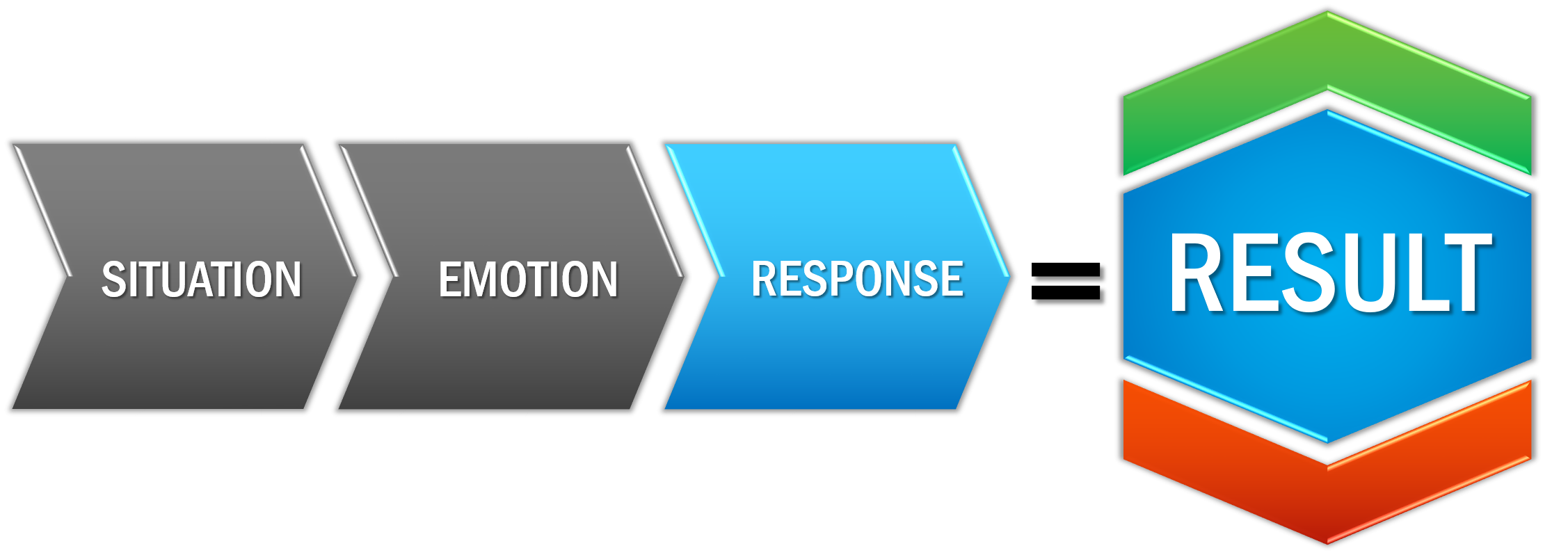
Of the five mindset components we’ve discussed to this point– from Focus, to Thoughts, to Emotions, to Body Reactions, to Behaviors– the SERR model zeros in on the relationship between just two of them: Emotions and Behaviors. The goal here is to gain awareness of how situations can naturally trigger emotions, and how those emotions can trigger behaviors if we don’t manage them. No matter what our emotions, it is our behaviors that will dictate our results.
Let’s animate how this works with a real-life example.
Some time ago, we had a hockey player struggling in his first NHL development camp. Every time he stepped on the ice, he was wondering what the coaches were thinking. He felt extreme levels of anxiety and found himself hesitating, missing easy passes/shots, and generally moving more timidly than he wanted. He wasn’t expecting to feel quite so nervous, so he was alarmed by how unsteady he felt on his skates.
He came in to meet with us after the first day of practice and we ran him through the SERR model. In his case, the situation was obvious: he was trying out with prominent coaches watching; his emotions were fear and anxiety; his response was that he played hesitantly, and the result was lackluster play and not wanting the puck.
We mapped it out for him, and his situation looked something like this:
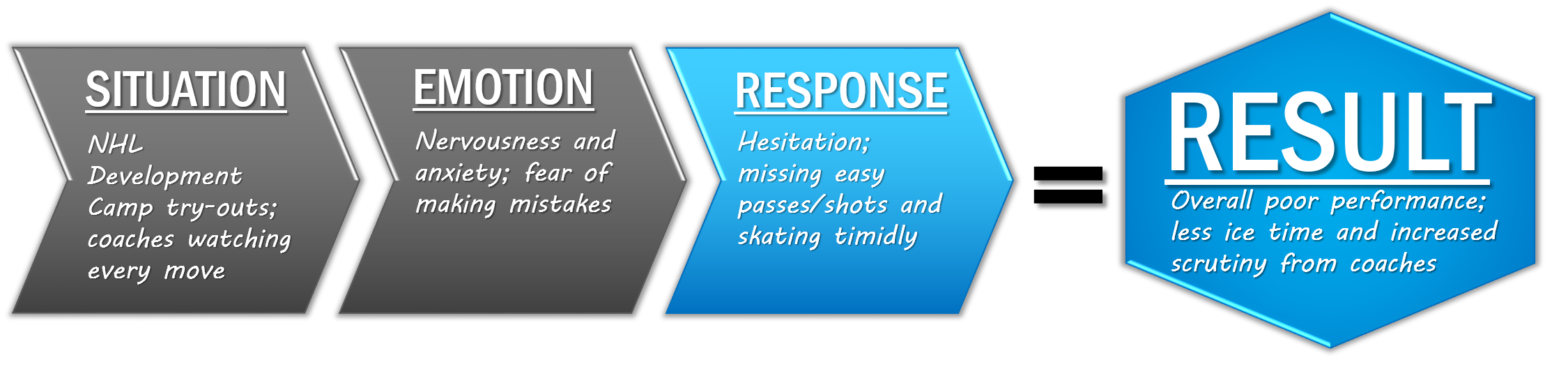
The bad news for this player: there was little he could do to change the situation or his anxiety. Neither were within his control, and would likely be the same tomorrow as they were today.
The good news: his behaviors and his performance needn’t be tied to his circumstances, or how he was feeling. He could feel anxious and still play hard. He could find the puck, finish checks, and make plays no matter how he was feeling. The answer was simply to identify which specific behaviors had reliably led to positive performances in the past, and to replicate them whenever he felt the situation or his emotions getting the better of him. For this athlete, it was playing fast and aggressive, going hard into the corners, and keeping his feet moving.
The objective of the SERR model is to acknowledge the situation and our emotions, but then to let them go, and shift our focus to the behaviors most likely to yield the results we’re targeting.
By following this plan, and cementing it with effective imagery where he imagined anxiety and overcoming it through his behaviors, the athlete was able to successfully re-draw the map to something like this, and to turn things around for the remainder of camp.

Using the SERR Model:
In any given situation, there is only one element in the SERR model that we have complete control over, and that is our behavior. We have limited control over our circumstances, and significantly less control over our emotional responses to those circumstances. And unfortunately, it is often in the most negative or unexpected situations when we feel in the least control of our emotions, and let them draw us into poor decisions and inferior play.
But if we can modify our behavior to challenge negative emotions– if we can walk with our shoulders back and our head high even when we feel unconfident– those behaviors alone can elicit chemicals in our body to combat undesired emotions and enhance positive ones, whether they be feelings of confidence, calm, joy, or energization. Therefore, an unconfident athlete can feel more confident simply by projecting confidence, a fatigued athlete can feel more energized simply by projecting energy, and an anxious or angry athlete can feel more at ease simply by projecting calm.
It’s that simple, and it’s that difficult.
Grow accustomed to confronting adversarial situations in these terms. Map them out. Summarize the situation honestly and concisely, use your emotional awareness to identify your emotions and your responses to those emotions, and take note of the result, even if your competition is still in progress (for example, perhaps you struck out or missed on a throw or a catch). Then identify your targeted result, and choose the behavioral response that will most likely manifest it.
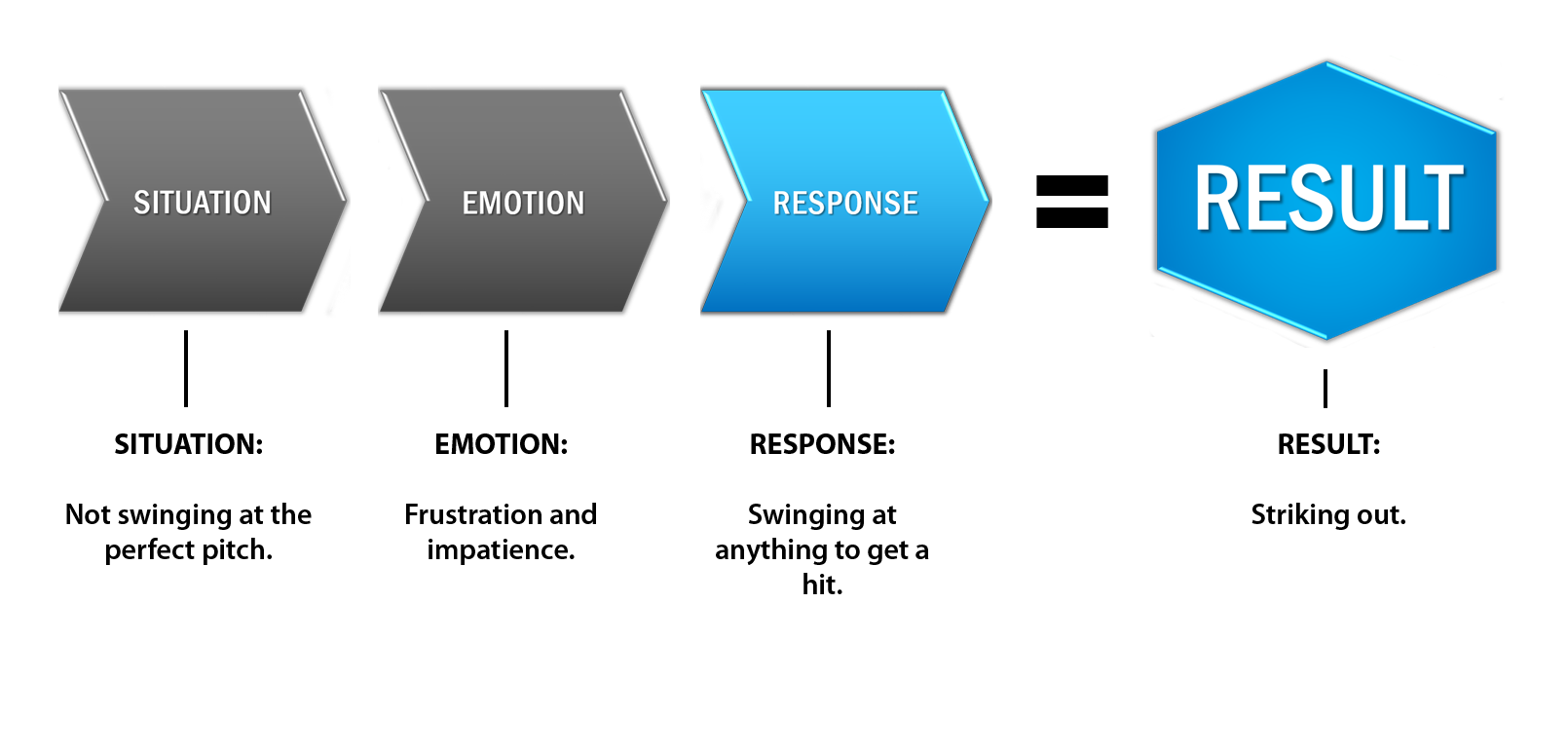

Give this process a practice run for yourself. Take a moment and identify a situation that triggered a negative emotion and map it on the worksheet below– from situation, through emotion and response, to result.
Whether your responses to this situation were ideal or unideal, we can always look for improvement, so in the second portion of the exercise, remap the situation and target a better response. If it helps, start with your desired result first, then work backward to a response most likely to deliver it. When thinking through conflict using the SERR in real life and real time, working backward from our desired outcome is the most common and effective approach.
EXERCISE SUMMARY: The second segment of this exercise is where the real growth can take place. We’ve all encountered situations that, with the benefit of hindsight, we wish we’d handled better. Revisiting these experiences allows us to evaluate precisely how we could have done so, and how we will do so in future performances.
As with all of these exercises– whether we are rehearsing potential situations or remembering actual ones– we are building and reinforcing mental routines that we can eventually practice in the moment when it really counts. So make a habit of building these SERR sequences, finding the best responses for optimal outcomes, and even fortifying them through imagery– imaging yourself feeling triggered, experiencing negative emotions, and responding with constructive behaviors that deliver your desired result.
Activation Curve
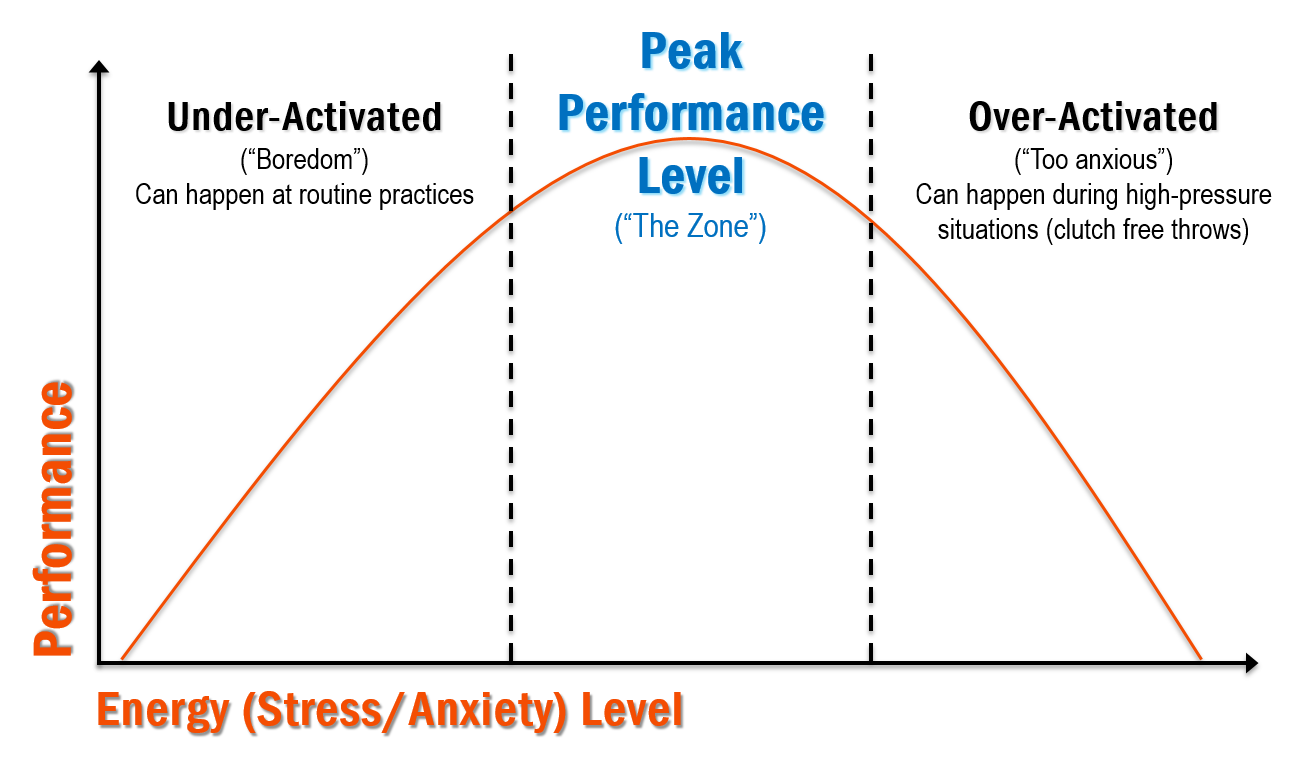
The Activation Curve charts your ideal energy/activation level for your individual performances. Along the horizontal axis is your activation level; this refers to your energy level at the time of your performance, ranging from completely unactivated at the left side of the axis (bored, lethargic) to hyper-activated at the right side (amped, anxious, jittery). Along the vertical axis is your performance level, ranging quite simply from poor performance at the bottom to peak performance at the top. The purpose of this graph is to help you determine what activation level is optimal for you to perform at your best in your particular sport.
You should not necessarily aim for your curve to look a certain way, but rather understand how it fits into your performance. The shape or path of your Activation Curve depends on what kind of sport you play, your role or position within that sport, and your personal disposition. For example, an Activation Curve for golf may peak at a lower energy level. High activation levels can make us jittery in our execution of fine motor skills, which can be problematic in sports that require exactness, precision, and accuracy. Conversely, an Activation Curve for powerlifting would look drastically different and may peak on the very high end of the energy axis. This is because powerlifters generally require much more energy to perform at their best, and utilize fewer fine-motor and decision-making skills than precision athletes.
In addition to the sport you play, your position within your sport could also change where your curve would be for optimal performance. A kicker in football, for instance, will typically prefer to feel calmer and less amped than, say, a defensive lineman, who may need a very high level of energy for optimal performance.
Finally, and most importantly, every athlete responds differently to energy and anxiety. Can you think of someone on your team who plays best when they are amped up and bouncing off the walls? What about a teammate who performs best when they are cool, calm and collected? Those athletes who intentionally increase or decrease their energy levels before or during a competition likely have a better understanding of where they need to be on their own Activation Curve to perform optimally. Where do you feel at your best? Consider the three factors we’ve listed– sport, position, and disposition– and make note of it on your own Activation Curve. As you approach competition time, be mindful of the energy needed (or not needed) for you to perform at your best, and work toward achieving that optimal zone.
Activation Curve Exercise:
To figure out your ideal activation level, chart your last five performances on the worksheet below (or draw your own graph in a notebook or training journal). Start with your performance level: how well did you play? A great performance would earn a mark high on the vertical axis, the performance axis. Now think about your activation level for that particular competition: how energized were you? If you were feeling “amped” and bouncing off the walls, drag the mark you made on the performance axis all the way to the right. If you were feeling flat, keep that performance mark all the way on the left. Find your spot, based on your performance and energy/activation levels, and draw a curve around it, like the one in the graphic and video above. Do the same for all five of your most recent performances, and note the differences between them.
DEBRIEF: Take special note of the curve reflecting your best performance (this will be the performance that has the highest peak on the graph). This reflects an activation level that works for you. It might not be the best performance in your career, but it gives you a place to start. You know you want to target an activation level at or near this level in your future performances, and you can use the skills located throughout this program– Imagery and breathing techniques in particular– to achieve it. Also take note of your least successful performance (this will be the lowest and flattest curve on the graph). This represents an activation level you want to avoid. The breathing techniques discussed in the section below, together with the videos in this section and the Imagery techniques noted in the Imagery module, all will help you modulate your activation levels before and during future performances.
Notice when your attention is focused on uncontrollables throughout your day. Apply the SERR Model in these moments. Bring your attention back to the controllables.
Bakker, A. (2011). Work Engagement. Presentation, Website. http://slideplayer.com/slide/4065823/.
Russell JA. Core affect and the psychological construction of emotion. Psychological Review. 2003;110:145 172.
Contributors: Videography by Neal Burke. Music by Klankbeeld. Music used with permission from http://www.freesound.org/