
You’ve undoubtedly heard that you should, “live in the moment” or “be present.” If you’ve tried it, you’ve likely found that it is easier said than done. Our bodies seem to accomplish this task with ease. Our lungs take in oxygen and exhale carbon dioxide from moment to moment without issue. Our heart beats without care for the past or worry of the future. Our minds, on the other hand, struggle to remain in the present. They drift. They examine the past and anticipate what’s to come. They think about the goal we missed last week and worry about the game we have next month. They fixate, which can lead us to distraction, mistakes, negative thoughts like self-criticism, negative emotions like worry or regret, and negative momentum.
Mindfulness, as a practice and a process, can pull us out of these negative loops by grounding us in the present moment and detaching us from unhelpful thoughts and emotions. It gives us the tools to view mistakes, unfair breaks, and other uncontrollables with acceptance and move forward, without compounding them by complaining, overreacting, and engaging with negative emotions. We observe, we accept, and we move on to the next pitch, the next play, the next competitive moment. We free ourselves to react within our competition with concentration and relaxation.
When we ask athletes what they were thinking when performing at their best, most respond that they were relaxed and not really thinking about anything. And while we know this isn’t true– we’re always thinking about something– the fact that their thoughts weren’t memorable means that their thoughts weren’t given primacy. They were just thoughts. Their focus was on the task and the present moment. These descriptions are characteristic of mindfulness.
So how does mindfulness work? It works by shifting us out of over-analysis to a mindset of acceptance and present-moment focus. An analytical mindset complicates and unpacks our circumstances—it looks for causes when bad things happen and it assigns blame. It judges situations as good or bad, and it anticipates consequences. An observing mindset accepts our circumstances for what they are without resistance or judgment. Doing so allows for something interesting to happen: our negative thoughts and emotions lose their power over us. They pass us by, rather than persisting and hooking us.
To better illustrate this mindset, consider a metaphor from the popular mindfulness website and application, Headspace. Mindfulness, or this observing mindset, is like relaxing near a busy street and observing the passing cars—just observing them, perhaps with interest, without becoming overly preoccupied with any particular car that passes.
The cars, in this metaphor, represent our thoughts. Most of us do not approach our thoughts in this way. We try to stop our thoughts, avoid our emotions, and as a result, we become stuck in them. Returning to the metaphor, we run out into traffic, and try to stop the cars. Mindfulness is about developing the ability to observe our thoughts and emotions, even the upsetting ones, without becoming engulfed in them. We no longer view our thoughts as something we need to avoid, analyze, or even believe—we approach them as we would cars passing along the road, and let them roll past.
Take a moment to complete this short exercise.
Begin by curiously observing what your feet feel like in this moment. Notice any points of contact they are making with the ground. What does that pressure feel like? Is it gentle pressure or firm pressure? Is your entire foot making contact with the ground or are parts of your feet hovering above the floor? Can you notice the feeling of your sock on your foot and around your ankle?
Now take a moment to observe any sounds that are occurring around you. As you notice them, rather than judging them as good or bad, just consider them sound waves hitting your ears. Notice the pitch of the sounds, notice the volume of the sounds. Now notice all of the colors that you can see around you. Notice their brightness, dullness, or vividness. Notice the texture on the surface of the walls around you. Notice these qualities with curiosity and interest— like you are seeing them for the first time. Take a breath and refocus your attention to this module.
That’s it. Mindfulness can be that easy. Remember, any time you are practicing mindfulness, you are further developing your mindfulness abilities, which can be called upon on-demand to positively impact your performance and improve your overall well-being.
Practice the S.T.O.P. sequence throughout your day. Reminder: Stop, Take a breath, Observe, and Proceed.
During practices or games, use the S.T.O.P. sequence to bring yourself to the present moment and notice the thoughts and emotions you are experiencing.
A good place to start is with Guided Meditations. Guided meditations provide us with direction and structure, and help us return to the meditation when our minds unavoidably wander on us. Many of these meditations will involve focusing on your surroundings, sensations, breathing, thoughts, or other occurrences within and around you.
There are many great phone applications available for guided meditations, and you can type “guided mindfulness meditation” into a search engine to find a variety of useful guided meditations online. These meditations will vary in length. We recommend starting with short meditations of 2-5 minutes and working your way up as you become comfortable. Most of the athletes we treat will work their way up to approximately 10-minute meditations, though those seeking optimal results can build up to 20 minutes.
SOME RECOMMENDED RESOURCES
Paid Resources: Calm, Headspace, 10% Happier
Free Resources: Oak Meditation and Breathing
Note: We are not spokespeople or affiliates of any of these applications, and receive no compensation for any sales generated by our program or its users. We recommend taking advantage of each paid application’s free trial period to see if it’s a fit for you.
Mindful breathing is a common practice of mindfulness meditation. Many people turn to mindful breathing because breathing is always with us and we can tap into this resource at virtually any time. As you begin practicing mindful breathing, expect your mind to frequently wander. Be patient. With practice, mindful breathing can yield powerful results.
Mindful breathing is different from controlled breathing in that with mindfulness, we are not trying to alter the breath, we are simply observing what breathing feels like. To begin this exercise, set yourself a timer for your desired meditation time– 2-5 minutes is a good place to start– find a comfortable place to sit or lay down free from distractions, and when you’re ready, get started below.
Sit comfortably on a chair or lay down on a bed and close your eyes. Once you’re comfortable, complete the meditation by directing your attention to your breath and observing what it feels like to breathe.
You can observe how your breathing feels in your stomach—focusing either on the surface and feeling your skin expand with each breath, or deep within, feeling the contracting and flattening of your diaphragm, whichever is easier for you. If this is too difficult, you can observe what it feels like as the air enters and exits through your nostrils.
As you observe this, soften your mind and try not to strain. Observe your breathing with curiosity. Your mind naturally focuses on a task when you approach it with curiosity. When your mind wanders, try to remain in the observing mindset. Observe that your mind has wandered, observe what it wandered to, and gently bring it back to your breath.
Much of mindfulness involves being aware of your surroundings and experiencing the present moment. It helps us accept everything that comes into our consciousness, regardless of what it might be. This is consistent with the first two steps of the AAA model: Acknowledgement and Acceptance. But while awareness and acceptance are vital first steps to improving your mindfulness, they alone are not enough to optimize your performance. We have to redirect to the task at hand.
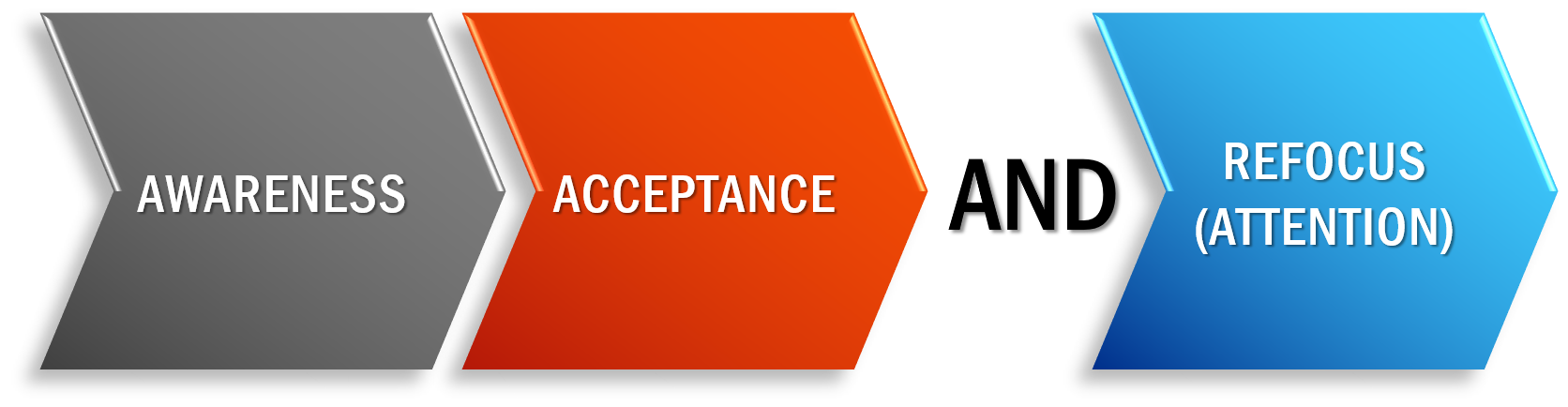
Consider a golfer approaching a critical putt and drawing his attention to his shaking hands. Being aware of his anxiety and accepting that his heart is racing may bring our golfer some relief, but it will not bring him any closer to sinking his putt. Instead, it will diminish his distractedness for long enough to refocus on the task at hand.
It’s the refocusing on the task, the final step of the AAA model: Acknowledge, Accept, And Refocus Attention; that allows us to use mindfulness to springboard past our distractions, and improve areas of our performance that might otherwise be difficult to execute under pressure, on demand, or when fatigued. Keep practicing mindfulness, grounding yourself in the present moment, and developing a healthy separation between yourself and your experiences, and its benefits to your performances and overall well-being will follow in kind.
Keep going.
During practice or games this week, when you feel yourself experiencing pressure or getting distracted, try using the AAA Model. Be Aware, practice Acceptance, and now refocus your Attention to the task at hand. Hint: you can use the S.T.O.P. sequence to increase your awareness in the first step of the AAA Model.
Research on the S.T.O.P. was collected from mindful.org
Contributors: Videography by Neal Burke. Music by Klankbeeld. Music used with permission from http://www.freesound.org/